.png)
Most homeowners who take financial planning seriously believe they’re prepared.
They’ve built emergency savings.
They budget carefully.
They pay their insurance premiums on time.
They’ve planned for the long term.
By most definitions, that is responsible financial behavior.
The problem is that financial preparedness is rarely tested in theory. It’s tested in real life—often suddenly—when a claim forces assumptions to collide with reality.
And that’s where many otherwise well-prepared homeowners discover that preparedness, by itself, isn’t always enough.
When homeowners think about financial planning, they usually think about things they can see and control:
Insurance, on the other hand, is usually handled once—often at the time of purchase—and then placed on autopilot.
Policies renew automatically.
Premiums adjust quietly.
Coverage details remain largely unchanged unless someone asks the right questions.
Over time, however, everything around the policy does change:
Yet the coverage designed to protect the home often remains assumed, not verified.
This isn’t neglect. It’s normal behavior.
It’s also where financial preparedness quietly begins to weaken.
Insurance is rarely scrutinized during calm periods.
It’s scrutinized during claims.
Claims are the stress test of financial preparedness. They are the moment when:
According to the Insurance Information Institute, the majority of homeowners insurance claims are not catastrophic losses. They are routine events such as water damage, wind damage, fire, or liability-related losses.
Water damage alone accounts for a significant percentage of homeowner claims each year, yet it’s also one of the most commonly misunderstood coverage areas.
This is where many homeowners learn—often for the first time—how their policy actually responds.
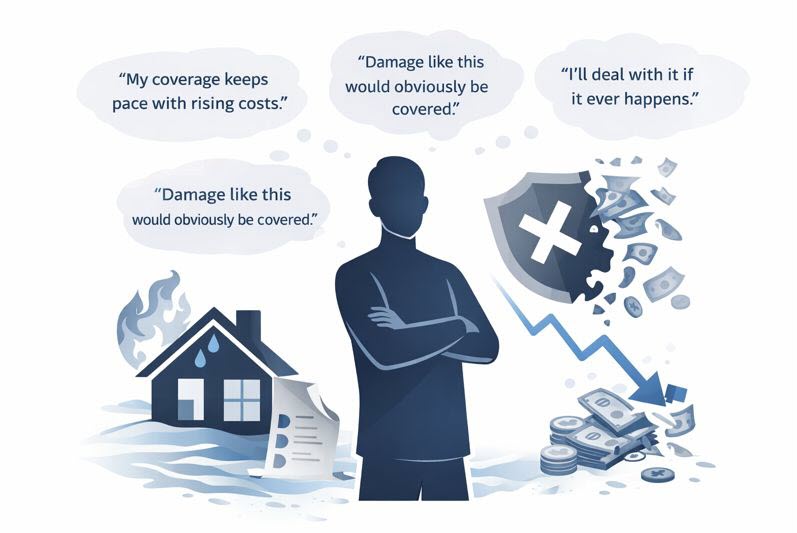
Most financial planning failures don’t come from a lack of effort. They come from assumptions that were never tested.
Assumptions like:
These assumptions feel reasonable. They feel responsible.
But when a claim occurs, assumed coverage becomes either confirmed—or disproven.
And when it’s disproven, the consequences aren’t theoretical. They’re financial.
This is why assumed coverage is such a quiet killer of financial planning: it doesn’t look risky until it’s too late to fix.
From the claims side, certain patterns appear again and again—across carriers, regions, and types of losses.
Not rare edge cases.
Not extreme disasters.
Everyday claims.
Common examples include:
According to NAIC consumer complaint data, claim disputes frequently arise not because damage didn’t occur—but because coverage didn’t apply the way homeowners believed it would.
These outcomes rarely feel like “bad luck.”
They feel like being blindsided.
When coverage falls short, the financial impact extends beyond the repair itself.
Homeowners often face:
CoreLogic and Verisk data consistently show that rebuild and repair costs have risen significantly over the past decade, often outpacing policy limits that haven’t been reviewed or adjusted.
These setbacks don’t always create immediate financial collapse—but they can take years to recover from, especially when they coincide with other financial obligations.
This is where financial preparedness is revealed not as a label, but as a reality.
Nearly everyone has heard stories about insurance not paying as expected.
Yet most people believe—quietly—that those stories won’t apply to them.
This is a well-documented behavioral pattern known as optimism bias: the tendency to believe negative outcomes are more likely to happen to others than ourselves.
It’s not ignorance.
It’s human nature.
But optimism doesn’t change policy language, coverage limits, or claim conditions.
And when preparedness is built on optimism rather than verification, it’s vulnerable.

True financial preparedness for homeowners isn’t just about planning and savings.
It’s about three components working together:
Savings – the buffer
Planning – the intention
Verification – the clarity
Verification doesn’t mean becoming an insurance expert.
It means knowing where you stand.
It means understanding whether assumptions hold up before a claim tests them under pressure.
This is the missing layer in most financial plans—and the one that determines whether preparedness actually works when it’s needed.
Before a claim, homeowners have options.
During a claim, they have constraints.
Once damage occurs:
This is why timing matters.
Verification only helps before damage forces the issue.
That’s where the Coverage Gap Check comes in.
It’s not a policy review.
It’s not a diagnosis.
It’s a screening.
The goal is simple: to help homeowners see whether their current coverage may be exposing them to financial risk—before a claim forces that discovery.
Most homeowners don’t discover coverage risks until damage has already occurred—when options are limited and changes can’t be made.
If you want clarity before that happens, start with our 60-second Coverage Gap Check.
It’s free, takes about a minute, and helps you see whether your current coverage may be exposing you to unnecessary financial risk.
Financial preparedness isn’t about avoiding every possible outcome. It’s about ensuring the plans you’ve made hold up when tested.
Knowing where you stand before a claim isn’t fear-based.
It’s financially responsible.
And it’s one of the most overlooked steps homeowners can take to protect what they’ve built.
.png)