
The Blind Spot in Most Financial Plans
Most financial plans are built around risks people can see.
Market volatility.
Inflation.
Interest rates.
Unexpected expenses.
These are the risks discussed in blogs, podcasts, and planning meetings. They fluctuate, they make headlines, and they demand attention.
But there is one financial risk capable of triggering immediate, unavoidable costs in the tens of thousands of dollars that receives far less scrutiny—despite how damaging it can be when it surfaces.
Not because it’s rare.
Not because it’s insignificant.
But because it’s quietly assumed to be handled.
That blind spot is how homeowners insurance actually responds when a real claim occurs.
Why Insurance Failure Hurts More Than Other Financial Setbacks
Most financial risks give you time.
Markets dip, then recover.
Budgets can be adjusted.
Investments can be rebalanced.
Insurance shortfalls don’t work that way.
When a homeowners claim is denied or underpaid, the damage still has to be repaired. Water still has to be removed. Mold still has to be remediated. Structures still have to be rebuilt. Homes can’t remain half-damaged indefinitely while financial decisions are reconsidered.
The costs that surface during claims are often immediate and non-negotiable:
Structural repairs
Water mitigation and drying
Mold remediation
Excavation and restoration
Code upgrades
Temporary displacement
These aren’t theoretical expenses. They arrive suddenly, under stress, and almost always at the worst possible time.
That’s what makes insurance failure uniquely dangerous from a financial planning perspective. When it fails, there is no graceful recovery period—only decisions made under pressure.
Real-World Example: A “Covered” Water Loss That Still Cost $38,000 Out of Pocket
To understand how this blind spot plays out in real life, it helps to look at a common claim scenario.
This scenario is not hypothetical. Variations of it appear frequently in:
NAIC consumer complaint summaries
State department of insurance bulletins
Homeowner accounts on Reddit (r/insurance, r/homeowners)
Claims case studies discussed by adjusters and restoration professionals
What Happened?
A homeowner experienced a supply line failure under a kitchen sink while they were away for the weekend.
Water spread through:
Kitchen cabinets
Hardwood flooring
Adjacent drywall and insulation
The damage was extensive, but not unusual.
The homeowner did what most people would do:
Filed a claim immediately
Contacted a mitigation company
Assumed the loss would be covered under their dwelling limit
What They Expected
The homeowner believed:
Water damage was covered
Their dwelling limit was more than sufficient
Insurance would “handle the repair”
Nothing about the situation felt like a denial risk.
What Actually Happened
During the claim review, the homeowner learned their policy included:
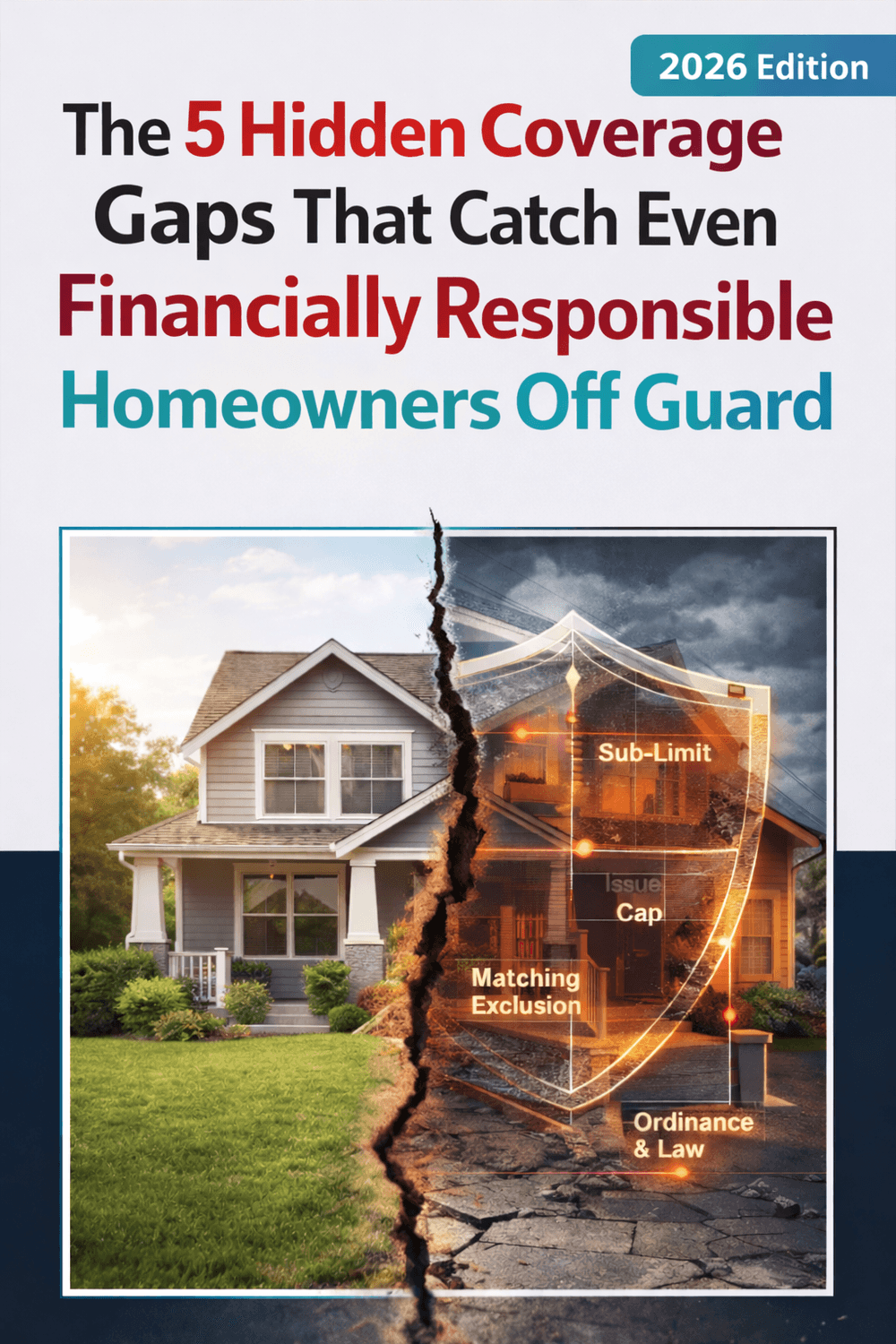
A water damage sub-limit
A fixed dollar cap that applied specifically to certain types of non-sudden water losses
The insurer paid up to the sub-limit.
Total repair, mitigation, and restoration costs came to approximately $62,000.
Insurance paid $24,000.
The remaining $38,000 was the homeowner’s responsibility.
The Critical Detail
The claim was not denied.
The damage was acknowledged.
Coverage technically applied.
But the limit, buried in the policy language and never reviewed after purchase, capped the payout.
The homeowner later stated they:
Never knew the limit existed
Never had it explained
Assumed water damage was covered like “any other damage”
Why This Was Preventable
This exposure could have been identified before the loss by:
Verifying whether water damage limits existed
Reviewing how water losses were defined and capped
Confirming whether endorsements were needed or limits adjusted
None of that required a claim.
None of it required damage.
None of it required becoming an insurance expert.
It required verification.
Why Financial Plans Feel Complete (Even When They’re Not)
Most homeowners do what they’re told to do.
They build emergency savings.
They plan for retirement.
They manage debt responsibly.
They pay their insurance premiums on time.
Insurance is treated as a solved problem.
It’s typically purchased once—often during a home purchase or refinance—and then placed on autopilot. Policies renew automatically. Premiums adjust quietly. Coverage details remain largely unchanged unless someone actively revisits them.
From the outside, the plan looks complete. Responsible. Thoughtful.
But something critical is missing.
Coverage vs. Confirmed Protection
There is an important difference between having insurance coverage and knowing how that coverage applies during a real claim.
Homeowners insurance policies are full of mechanisms that only matter once damage occurs:
Sub-limits that cap certain types of losses
Endorsements that modify coverage in narrow ways
Conditions that must be met for coverage to apply
Exclusions that quietly remove protection
Notification requirements with strict timelines
None of these affect day-to-day life.
None of them show up in a budget.
None of them create friction—until a claim forces them into relevance.
And once a claim begins, these details can’t be changed.
Why This Blind Spot Persists
Most homeowners don’t ignore insurance out of carelessness.
They assume it’s being handled.
Common assumptions sound reasonable:
“My agent would tell me if something changed.”
“Coverage is reviewed at renewal.”
“If it’s common damage, it’s obviously covered.”
These assumptions aren’t reckless. They’re normal.
But they don’t account for how the insurance system actually operates.
The Structural Reality: Sales Expertise vs. Claims Reality
Insurance operates across two very different domains.
Insurance agents are experts in:
Policy placement
Coverage options
Pricing and eligibility
Helping homeowners select policies
Claims professionals are experts in:
How policy language is interpreted
How exclusions and conditions apply
How limits function under real damage
What actually gets paid—and what doesn’t
These are not the same skill sets.
Agents specialize in selling and servicing coverage. Claims professionals specialize in applying policy language after damage has occurred. Their interaction is often limited—and usually reactive.
Why Non-Captive Agencies Increase Complexity
Many agents today are independent, meaning they represent multiple insurance carriers rather than a single, captive insurer.
This benefits homeowners at purchase by offering more choice. But it also introduces complexity that’s rarely discussed.
Every carrier has different:
Policy language
Endorsements
Sub-limits
Claims interpretations
From a claims-handling standpoint, it’s unrealistic to expect deep, real-world expertise across every carrier’s policy behavior.
As a result, no single party is continuously verifying how coverage performs once it’s tested.
The Missing Feedback Loop
There is very little proactive education flowing between:
Claims departments
Insurance agencies
Homeowners
Most interaction between agents and claims departments occurs after a claim happens—when coverage is already locked, damage is already done, and financial exposure is already real.
Policies are sold based on summaries.
Claims reveal how coverage actually applies.
Homeowners are left to reconcile the difference.
No one is acting in bad faith.
The system simply isn’t designed for ongoing verification.
When Financial Plans Are Actually Tested
Claims are the real-world stress test of financial preparedness.
They are sudden.
They are expensive.
They are emotionally charged.
Once a claim begins:
Coverage can’t be expanded
Limits can’t be increased
Endorsements can’t be added
Notification windows begin closing
This is when homeowners learn—often for the first time—how their policy actually works.
Why Financially Responsible Homeowners Are Often the Most Surprised
This blind spot doesn’t disproportionately affect careless homeowners.
It affects homeowners who:
Trust systems once they’re set up
Delegate appropriately
Avoid unnecessary micromanagement
Assume safeguards are functioning as intended
That trust usually works—until assumptions are tested under pressure.
When they fail, the consequences aren’t philosophical. They’re financial.
The Real Financial Fallout of Underinsured or Denied Claims
When coverage falls short, the impact goes far beyond the repair itself.
Homeowners often face:
Tens of thousands of dollars in out-of-pocket costs
Emergency savings depleted or eliminated
Increased reliance on credit
Delayed or partial repairs
Long-term financial setbacks
These outcomes rarely look like dramatic disasters. They look like years of lost progress.
The Missing Layer in Most Financial Plans: Verification
True financial preparedness has three components:
Savings — the buffer
Planning — the intention
Verification — the clarity
Verification doesn’t mean becoming an insurance expert.
It means knowing where you stand before a claim forces the answer.
Why Timing Matters More Than Knowledge
Knowledge gained during a claim has limited value.
Timing determines options.
Verification only helps before damage occurs—not after.
This is the difference between prevention and reaction.
Closing the Blind Spot
Financial plans are designed to protect progress.
The most dangerous threats to that progress don’t announce themselves. They don’t fluctuate daily. They don’t feel urgent.
They remain assumed—until timing makes them expensive.
Knowing where you stand before a claim isn’t fear-based.
It’s financially responsible.
And it closes the most overlooked blind spot in modern financial planning.
A Simple Next Step
Most homeowners don’t discover coverage risks until damage has already occurred—when options are limited and changes can’t be made.
If you want clarity before that happens, a simple screening can help identify whether your current coverage may be exposing you to unnecessary financial risk.
Sometimes, knowing where you stand is the most valuable part of being prepared.

James H. Finks III
James has spent more than 15 years working inside the insurance claims industry. After seeing too many homeowners blindsided by coverage denials and underpayments, he created Happy Adjuster to help responsible homeowners prevent costly surprises before a claim ever happens.

Coverage Insights, Claim Readiness, Policy Clarity, and Homeowner Protection Resources
Created with ©systeme.io